
Fixed-Price vs. Time and Materials
20 August 2026
Which Contract Actually Serves Your Residential Construction Project Better?
Choosing the right contract structure is one of the most important decisions you’ll make on a residential construction project. It affects your budget, timeline, stress level, and how flexible the work can be as the job progresses.
Two common options dominate residential construction: fixed-price (also called fixed-bid or lump-sum) and time and materials (T&M). Both have clear strengths and real drawbacks. Neither is automatically “better.” The right choice depends on how clear the scope is, how much change you expect, and how involved you want to stay during the project.
Here’s a straightforward breakdown so you can decide with your eyes open.
Fixed-Price Contracts
In a fixed-price agreement, the contractor gives you one total price for a clearly defined scope of work. That number includes labor, materials, overhead, and profit. Once both sides sign, the price is locked unless you approve a formal change order.
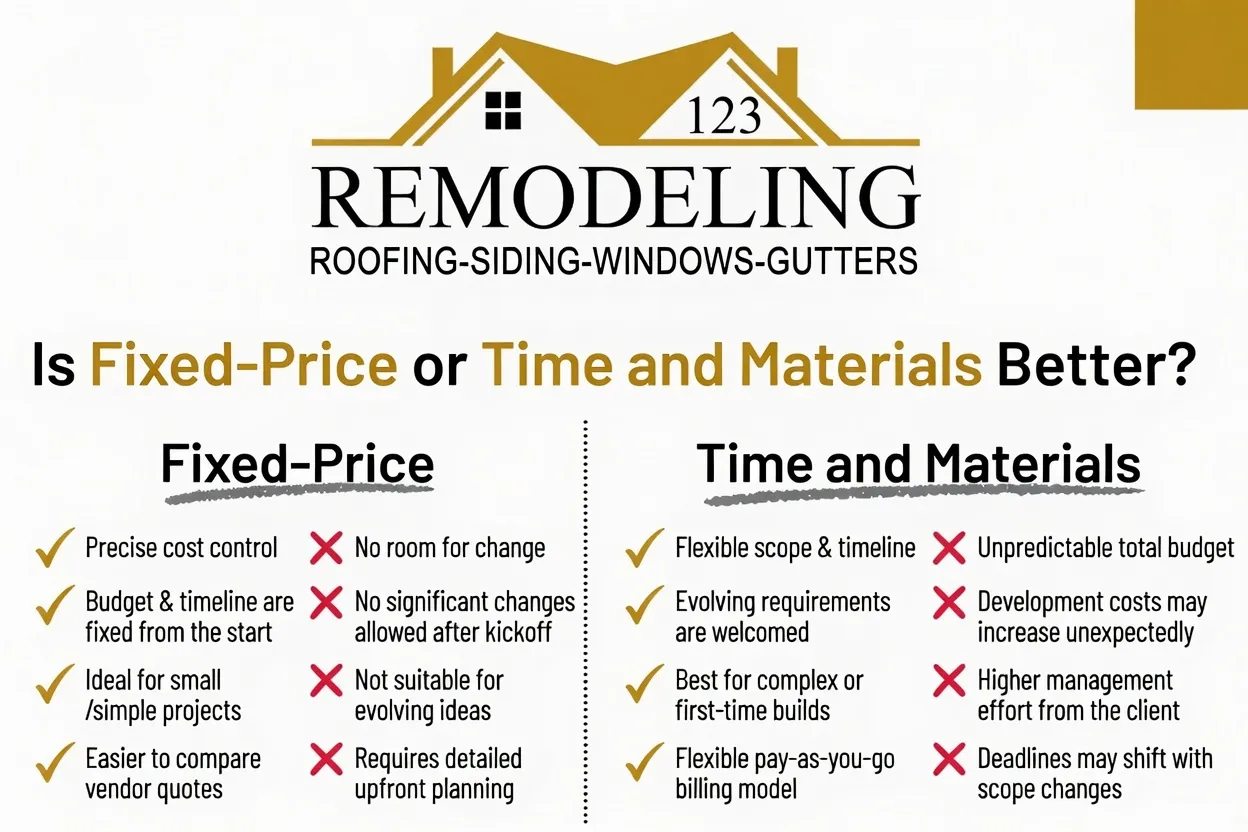
Advantages | Disadvantages |
Precise cost control — You know the total number going in | Rigid scope — Almost no room for change once work begins |
Fixed budget and timeline — Both are locked in from the start | Costly changes — Significant changes require change orders and added cost |
Ideal for simple projects — Best for small tasks with few unknowns | Inflexible for evolving ideas — Not suitable when conditions are still fluid |
Easier quote comparison — Simplifies comparing contractor bids apples-to-apples | High upfront effort — Requires detailed planning and a complete scope before starting |
Fixed-price works best when the plans are solid, the site conditions are known, and you want maximum price certainty. Many homeowners prefer it because it removes the fear of an open-ended bill.
Time and Materials Contracts
With time and materials, you pay for the actual hours worked plus the cost of materials (often with a markup). The contractor usually provides an estimate range, but the final cost depends on how long the work takes and what materials are needed.
Advantages | Disadvantages |
Flexible scope and timeline — Easily adapts as work progresses | Unpredictable total budget — Hard to pinpoint a final figure upfront |
Welcomes evolving requirements — Changes are embraced instead of resisted | Unexpected cost increases — Development expenses can grow as requirements expand |
Ideal for complex projects — Best for first-time builds where unknowns are likely | Higher management effort — Requires active, ongoing engagement from the client |
Pay-as-you-go billing — Offers a flexible billing model tied to actual work | Shifting deadlines — Target completion dates may move as scope changes |
T&M is often the more honest choice when the project has moving parts — older homes with hidden conditions, design decisions that will be made along the way, or work that depends on what is found once walls are opened.
How to Decide
Ask yourself a few practical questions:
1. How complete are the plans and specifications?
Fully detailed drawings and a locked-in scope → fixed-price usually wins.
Still refining finishes, layouts, or systems → T&M is often safer.
2. How much change do you expect?
If you know you’ll want to adjust things once you see them in person, fixed-price will frustrate everyone. T&M handles that naturally.
3. How involved do you want to be?
Fixed-price lets you step back more. T&M requires regular communication and review of time and material logs.
4. What is your tolerance for budget risk?
Absolute cost certainty → fixed-price.
Willingness to pay for actual work in exchange for flexibility → T&M.
Many successful residential projects use a hybrid approach: a fixed-price core for the well-defined portions and T&M allowances for areas with high uncertainty (demo, structural surprises, finish selections that are still open).
A Note on Trust and Transparency
No contract type protects you from a contractor who is not straightforward. The structure only works when both sides communicate clearly, document changes, and operate with the same definition of fairness. A fixed-price bid that is unrealistically low often leads to change-order battles later. A T&M arrangement without clear reporting and agreed hourly rates can drift.
The healthiest projects start with a contractor who explains the trade-offs honestly up front rather than pushing the contract type that is easiest for them.
Bottom Line
- Choose fixed-price when the work is well-defined, the unknowns are low, and cost certainty is your top priority.
- Choose time and materials when flexibility, evolving decisions, or complex conditions make a rigid number unrealistic.
Neither option is inherently better. The better contract is the one that matches the actual nature of your project and the level of partnership you want with the people doing the work.
If you’re planning a residential construction or renovation project and want help thinking through which structure fits your situation, the right conversation at the beginning can save a lot of friction later.